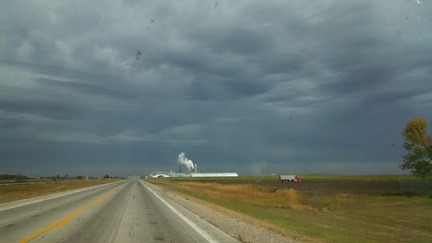
American Crystal Sugar Company
Hillsboro Processing Plant
Hillsboro, ND
GPS: 47.434612, -97.062921
Profile of the Sugar Beet (Beta vulgaris)
Size between a coconut and a football
The sugar beet has a conical, white, fleshy root (a taproot) with a flat crown. The plant consists of a root and a rosette of leaves. Sugar is formed by photosynthesis in the leaves and is then stored in the root.
A sugar beet weighs between two and five pounds. The foliage has a rich, brilliant green color and grows to a height of about 14 inches. The leaves are numerous and broad and grow in a tuft from the beet crown, which is usually level with or just above the ground surface.
The beet root contains 75% water, about 20% sugar, and 5% pulp. The exact sugar contents can vary between 12% and 21% sugar, depending on the cultivar and growing conditions.
Sugar is the primary value of sugar beet as a cash crop. The pulp, insoluble in water and mainly composed of cellulose, hemicellulose, lignin, and pectin, is used in animal feed. Sugar beet by-products, such as pulp and molasses, add another 10% to the value of the harvest.
Sugar beets grow exclusively in the temperate zone, in contrast to sugar cane, which grows exclusively in the tropical and subtropical zones. The sugar beet is a root crop that flourishes in temperate climates where the growing season is about five months long. Farms are found in California, Colorado, Idaho, Michigan, Minnesota, Montana, Nebraska, North Dakota, Oregon, Washington, and Wyoming.
Beets are planted in late March/early April and harvested in late September and October. When fully grown, a sugar beet is about a foot long, weighs two to five pounds, and is about 18% sucrose. They are processed at 23 factories located near the fields because beets are a perishable vegetable. Factories generally operate around the clock, seven days a week, from October through April. Beet sugar represents about 54% of domestically-produced sugar. There is no difference between beet and cane sugar.
Some beet sugar brands you might recognize are Crystal Sugar, Holly Sugar, Western Sugar, Big Chief Sugar, Pioneer Sugar, White Satin, and Spreckels Sugar.
In addition to processing pure beet sugar, sugar factories also produce a by-product known as dried beet pulp. The pulp is the dried fiber residue left after most of the sugar has been extracted from the sliced beets. Dried beet pulp can be produced and shipped in many forms: plain dried, molasses dried (which contains approximately 25 percent molasses) and pelleted.
This excellent feed is valued by dairy farmers to stimulate the cow’s milk flow and is widely used to feed cattle and sheep destined for market. In recent years, substantial quantities of pelleted dried beet pulp have been exported to Japan and Europe to assist their development of feeding programs and, in turn, help our country's balance of payments.
Another important by-product is beet molasses, produced in quantities ranging from 4 % to 5% by weight of the beet and containing about 50 percent sugars. Beet molasses is used for the production of yeast, chemicals, and even pharmaceuticals, as well as the production of mixed cattle feeds. It is one of the best mediums for liquid cattle feed.
Thanks to several public industry sources for the information above
Posts about the Sugar Beet Harvest
FIRST DAY IN NORTH DAKOTA
Hillsboro, North Dakota, we have arrived
GETTING READY FOR WORK
Some paperwork to get us started
ON THE JOB TRAINING
A trip to the Hillsboro factory for some OJT
TEN DAYS OF WORK
Notes and pictures on our ten days of work
THE CAMPAIGN
A quick summary of the annual campaign of sugar beet processing
THE SUGAR BEET
Bigger than a coconut, smaller than a football. Here is the story on the sugar beet
THE PILER
I was very impressed with the big machine we worked on. I thought you might like to learn more.
THE SUGAR BEET PILE
How big is a pile that contains 90,000 tons? Here are some pictures and figures
DOWN AND DIRTY: GIVING BACK THE TARE DIRT
Harvesting root crops produces dirt. How to handle and dispose of it is an interesting side story
A LOOK AT THE SUGAR INDUSTRY
A $20 billion industry with 142,000 jobs in 22 states. Take a look at the Sugar Beet Industry
AMERICAN CRYSTAL SUGAR COMPANY
Get a closer look at the company providing this workamping opportunity.
EXPRESS EMPLOYMENT PROFESSIONALS
If you are a workamper interested in short term hard work for big bucks, here’s the link
American Crystal Sugar Company
Hillsboro Processing Plant
Hillsboro, ND
GPS: 47.434612, -97.062921
As I was doing the research for this story, I noticed the word “campaign” was used often. Thinking about that, the word makes sense because the process is an annual agricultural thing. It may begin in the summer, but for sure it begins by 01 Oct at the start of harvest. I suspect it ends the following spring when all the beets are processed and the processing yards are empty and ready to start again. So how does the campaign get named? If named for the year of harvest, it would be “the 2015 campaign”. If named for the year when the process is complete and all the product is sold or for sale, it would be “the 2016 campaign”. I don’t know the answer?
My understanding is this. American Crystal Sugar Company is an agricultural cooperative. Every year they contract with each of their members to grow and deliver a certain amount of sugar beets. I suspect the unit of measure is acres, since the tons of beets or pounds/tons of sugar is determined by Mother Nature and is unknown until the campaign is in the books.
During the summer, company Agriculturalists visit the fields to check on the growing crops, advise the farmers, and predict what the harvest will look like.
Pre–pile harvest begins in early September. Harvest deliveries are limited and controlled due to the warm weather and poor storage conditions. This limited harvest allows growers to open roadways through fields in preparation for the main harvest, which begins October 1.
Growers deliver their sugar beets to a designated receiving station located throughout the growing area. Sugar beets are harvested with two primary pieces of equipment. The Defoliator removes the green leaves and slices a slab from the top of the sugar beet root. This removed slab is the growing point of the sugar beet and contains high levels of impurities, which impede the factories ability to extract the sugar from the remainder of the harvested root. The sugar beet root is then harvested with a Pinch Wheel Harvester, which pinches the root and lifts it from the soil. The sugar beet harvester also separates some soil and conveys the sugar beet into a truck to be transported to a receiving station.
A Sugar Beet Defoliator
A Pinch Wheel Harvester
Trucks hauling sugar beets to receiving stations are weighed and off loaded on sugar beet pilers. These machines also screen soil from the sugar beets and pile the sugar beets in large storage piles. Samples of sugar beets are taken upon delivery to be analyzed for sugar content, purity and tare.
Sample Bags Ready for Transport
Harvest is concluded in late October.
Throughout the winter, sugar beets are reloaded into rehaul trucks, which deliver the stored sugar beets to the factory for processing. Large front-end loaders load belly dump trailers which haul 27 tons per load. Piles are monitored for temperature during the storage term. Some piles are also passive ventilated or forced ventilated to enhance storage conditions and allow sugar beets to be stored for longer periods. Sugar beets can be stored in piles as long as mid-March when the slicing operations will be completed. Then, it is time to begin the process all over again.
A Belly Dump Trailer
Posts about the Sugar Beet Harvest
FIRST DAY IN NORTH DAKOTA
Hillsboro, North Dakota, we have arrived
GETTING READY FOR WORK
Some paperwork to get us started
ON THE JOB TRAINING
A trip to the Hillsboro factory for some OJT
TEN DAYS OF WORK
Notes and pictures on our ten days of work
THE CAMPAIGN
A quick summary of the annual campaign of sugar beet processing
THE SUGAR BEET
Bigger than a coconut, smaller than a football. Here is the story on the sugar beet
THE PILER
I was very impressed with the big machine we worked on. I thought you might like to learn more.
THE SUGAR BEET PILE
How big is a pile that contains 90,000 tons? Here are some pictures and figures
DOWN AND DIRTY: GIVING BACK THE TARE DIRT
Harvesting root crops produces dirt. How to handle and dispose of it is an interesting side story
A LOOK AT THE SUGAR INDUSTRY
A $20 billion industry with 142,000 jobs in 22 states. Take a look at the Sugar Beet Industry
AMERICAN CRYSTAL SUGAR COMPANY
Get a closer look at the company providing this workamping opportunity.
EXPRESS EMPLOYMENT PROFESSIONALS
If you are a workamper interested in short term hard work for big bucks, here’s the link
American Crystal Sugar Company
Hillsboro Processing Plant
Hillsboro, ND
GPS: 47.434612, -97.062921
There was not much opportunity for socializing beyond the members of our piler crew. However, I could easily see that the labor force was diverse — male, female; old, young; all ethnicities, with many Spanish speaking; very big men to petite women. We did get to meet one man who was living at our campground with his family. He worked the day shift, his wife worked nights. For about an hour, twice a day, at shift change, the Camp Host watched the kids while Mom and Dad switched.

It didn’t take long for us to get acquainted with the truck drivers and discern distinct patterns. Most of the farms are agri–businesses. Some operating a fleet of 25 or more trucks. Some had the crops they farm included in their logo. One, for example, had a sugar beet, an ear of corn, and a sheaf of wheat cleverly woven into the name of the farm to make his logo on the doors of his trucks.
We learned that many drivers were hired by the farmers just for the harvest and they too were working twelve-hour shifts. One told us that it takes about seven minutes to fill the truck and the truck holds beets from roughly one acre of land. It takes less than five minutes to dump the beets. Add some time for waiting in lines at the piler and twice at the weigh station. The rest of the time is commuting to and from the fields. Farmers close-by cycle much faster than those far out. So we could see the same truck and driver every half hour or so. During busy times, trucks were lined up three or four deep on both sides of the piler.
Sometimes wives and kids would ride along. Sometimes wives would drive themselves. Some hired drivers were women. One female hired driver was a single Mom from out of state and her son accompanied her almost all the time.
Then there was the “pink lady”. Dang! I didn’t get a picture of her. One female driver wore a pink sweatshirt, a pink baseball cap, and makeup to the hilt. It only took a couple cycles to recognize her. One evening after work, I stopped at Casey’s General Store and she was working the cash register (without the sweatshirt and baseball cap). As I was checking out, I asked, “Do you have a pink baseball cap?” She lit up and replied “Yes. Are you working on piler #3?” I think most people have more than one job just to get by.
On the front bumper of just about every truck is a fixture obviously meant for pulling the truck. I never noticed these on highway trucks. Since farm trucks spend a lot of time in the fields they get stuck in the mud often. These fixtures are for quick and easy hook up to pull them out.
With many different makes of trucks, I started taking pictures of the front grill works thinking I might make a picture album for our grandsons. We’ll see.
When a truck arrives at the piler, he/she pulls through, then the operator opens the hopper behind them. The truck backs up against the hopper and raises the trailer to dump the beets. Forward, Back, Box Up, Box Down instructions are transmitted from the operator to the driver by lights positioned so that the driver can see them.
Believe it or not, this was the first time in my life I had to punch a time clock. We had to clock in no earlier that seven minutes before eight and clock out no later than seven minutes after eight. So just around eight o’clock, the little building with the time clock got very busy. Thirty-six people clocking in followed immediately by thirty-six people clocking out.
Work shifts were twelve hours long – 8 to 8. We worked days. On the very first day, they tried to assign us to the night shift. We put our foot down on that. When we signed up last January and again when we did all the paperwork at the beginning, we specified “days only”. We were not willing to stand out in the cold all night. They resolved that situation to our satisfaction.
When we arrived for work in the morning, the sun was up and bright but it was still cold. As the day progressed, we peeled off layers of clothing. Then at sunset we began putting them back on. The last two hours were always dark, cold, and long. We looked forward with anticipation to the approaching headlights of the night shift. Sometimes it was just another truck wanting to be our last customer for the day.
We were allowed to bring our vehicles to the area near the piler so our truck became the place where we took breaks and ate lunch. We purchased enough freezer blocks to have two sets – one working in the portable cooler and one at home in the freezer. We switched them every morning.
Every day we brought sandwiches, six bottles of water, and one or two containers of yogurt in the cooler. Plus we had packages of cheese crackers, peanut butter crackers, and bags of peanuts in our truck. So at every break, we used the Porta–John then went to our truck for something to eat and drink.
Most trucks we encountered during the sugar beet harvest were clean and well cared for. Dirty at the moment because of their job, under the dirt you could see a fine piece of machinery. But this old guy got into my head and cracked open the memory of a movie I saw long ago.
Time for some research. The only memory string I had to grab was my recollection that the main character of the movie was Dennis Weaver. That's all it took. A quick search brought it all back.
The movie was Duel. Filmed in 1971, it was Steven Spielberg's first directing job. The film's protagonist, David Mann (played by Dennis Weaver), while traveling on a freeway, gets chased by a big truck whose driver, for no explained reason, wants to kill him. The truck, a large rusty 1955 Peterbilt 281 gasoline tanker is one of the most sinister automotive movie characters ever. The truck driver is never fully shown. This gives more character to the truck, to the point that the vehicle becomes the actual antagonist.
I think I’ll buy the CD and scare the snap out of my grandsons during our Christmas visit.
If this interests you, check out these two websites
Unsung Films
Movie Fanfare
Back on the subject. Without the Skidsteer, the area around the piler would quickly become overwhelmed with trash. Beyond that, we worked at keeping our work area clean. We cleaned up with shovels and brooms what the Skidsteer could not reach. Crushed beets made a mess faster than the Skidsteer could keep up, especially since the Skidsteer had the task of laying down the culvert for the forced ventilation system. Mud quickly built up on the bottom of our boots. Scraping off the mud and sweeping it away was a constant chore.
After the first week, things slowed down. Drivers reported that they had only two or three days of work left to empty the fields. We noticed some farms disappear from the lineup and truck traffic was definitely thinning out. Some piles were full and were being shut down, with the workers being assigned to other pilers. That gave us too many people and we were tripping over each other. We knew the harvest was about over. On Saturday, 10 Oct, we got the call from Express Employment Professionals telling us we were done. Any remaining work would be handled by the full–time employees. I sent this ePostcard to our workamping friends
Not unexpectedly, fatigue was a problem for us. We are not in great shape physically and standing on concrete for twelve hours straight did have an effect. The first night we were absolutely wiped out – straight home, leave the muddy boots outside, grab a snack, and crash. It got better as the days passed (maybe it was the pain pills). However, accumulated fatigue began to take hold and by the last day I hurt from head to toe. We signed up expecting three weeks. By day ten I seriously doubted that I could have made three weeks.
When Express Employment Professionals called to “lay us off”, I asked about how fast we had to vacate the campground. They said, “Don’t worry about it. Take your time”. The campground manager told me that EEP had rented and paid for sixty sites for forty–five days, so there was no hurry to clear out. That was good to hear. We took a couple days to relax, do one last laundry, and pack up. We left Hillsboro on Wednesday, 14 Oct and began our trip east.
Posts about the Sugar Beet Harvest
FIRST DAY IN NORTH DAKOTA
Hillsboro, North Dakota, we have arrived
GETTING READY FOR WORK
Some paperwork to get us started
ON THE JOB TRAINING
A trip to the Hillsboro factory for some OJT
TEN DAYS OF WORK
Notes and pictures on our ten days of work
THE CAMPAIGN
A quick summary of the annual campaign of sugar beet processing
THE SUGAR BEET
Bigger than a coconut, smaller than a football. Here is the story on the sugar beet
THE PILER
I was very impressed with the big machine we worked on. I thought you might like to learn more.
THE SUGAR BEET PILE
How big is a pile that contains 90,000 tons? Here are some pictures and figures
DOWN AND DIRTY: GIVING BACK THE TARE DIRT
Harvesting root crops produces dirt. How to handle and dispose of it is an interesting side story
A LOOK AT THE SUGAR INDUSTRY
A $20 billion industry with 142,000 jobs in 22 states. Take a look at the Sugar Beet Industry
AMERICAN CRYSTAL SUGAR COMPANY
Get a closer look at the company providing this workamping opportunity.
EXPRESS EMPLOYMENT PROFESSIONALS
If you are a workamper interested in short term hard work for big bucks, here’s the link
Hillsboro Campground
203 6th St SW
Hillsboro, ND 58045
GPS: 47.399616, -97.072165
Yesterday we did employment paperwork; today we went to the Hillsboro Processing Plant for a four-hour hands–on training session.
Our worksite, the Hillsboro Yard, was about a mile north of town
We got our hard hats, safety glasses, and vests, ...
... then we got to meet a real Sugar Beet Piler, ...
... and learn about our job.
We worked with a few trucks ...
... took some samples ...
... and got to be friends with our trainers
Michelle and Mary
Mary is a nursing student from Texas. She comes to the beet harvest every year to earn money for tuition. Many of these folks are second and third generation harvest workers.
This adventure will definitely be something we have never experienced before.
Posts about the Sugar Beet Harvest
FIRST DAY IN NORTH DAKOTA
Hillsboro, North Dakota, we have arrived
GETTING READY FOR WORK
Some paperwork to get us started
ON THE JOB TRAINING
A trip to the Hillsboro factory for some OJT
TEN DAYS OF WORK
Notes and pictures on our ten days of work
THE CAMPAIGN
A quick summary of the annual campaign of sugar beet processing
THE SUGAR BEET
Bigger than a coconut, smaller than a football. Here is the story on the sugar beet
THE PILER
I was very impressed with the big machine we worked on. I thought you might like to learn more.
THE SUGAR BEET PILE
How big is a pile that contains 90,000 tons? Here are some pictures and figures
DOWN AND DIRTY: GIVING BACK THE TARE DIRT
Harvesting root crops produces dirt. How to handle and dispose of it is an interesting side story
A LOOK AT THE SUGAR INDUSTRY
A $20 billion industry with 142,000 jobs in 22 states. Take a look at the Sugar Beet Industry
AMERICAN CRYSTAL SUGAR COMPANY
Get a closer look at the company providing this workamping opportunity.
EXPRESS EMPLOYMENT PROFESSIONALS
If you are a workamper interested in short term hard work for big bucks, here’s the link